Number of Volumes: 6
Number of Issues: 22
Number of Articles: 139
Number of Authors: 246
Total Article Views: 87525
Total Full-Text Article Downloads: 70,228
Number of Submitted Manuscripts: 312
Number of Rejected Manuscripts: 90
Number of Accepted Manuscripts: 99
Average Time to Acceptance (Days): 130
Acceptance Rate: 32
Average Views per Article: 629.68
Average Downloads per Article: 505.24
Number of Indexing Databases: 5
Publication Format: Print and Online
Publication Frequency: Quarterly
Languages of Publication: Persian and English
Manuscript Submission: Online submission system only
Article Processing Charges (APCs): None
Free and Open Access to Articles: Yes
The Quarterly Journal of Defense Human Capital Management of Imam Ali Officer University is proud to adopt a new approach to defense human resources by disseminating the latest theories and scientific findings of scholars, faculty members, experts, and researchers in the fields of human resource management within the domains of defense, national security, and strategic management.
The Quarterly Journal of Defense Human Capital Management, affiliated with Imam Ali Officer University, was authorized under License No. 98/287471, dated January 11, 2021, issued by the Commission of the Ministry of Culture and Islamic Guidance, and registered under Registration No. 87436. Furthermore, pursuant to Directive No. 11-25685, dated April 29, 2019, issued by the Ministry of Science, Research, and Technology, the journal has since operated as a scientific journal.
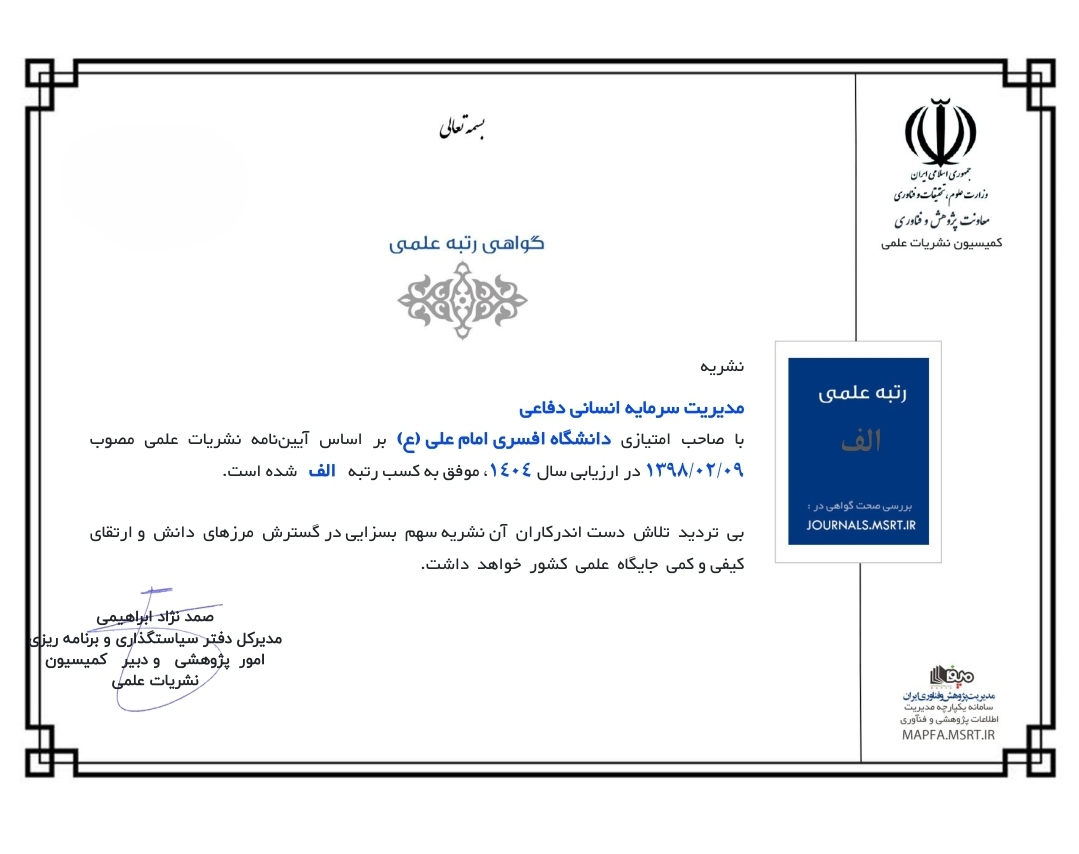
Furthermore, according to the latest evaluation conducted by the Commission for Scientific Journals of the Ministry of Science, Research, and Technology (MSRT), the journal has been awarded the highest grade, Grade A.
This journal adheres to the ethical standards and guidelines of the Committee on Publication Ethics (COPE) and complies with the implementing regulations of the Law on the Prevention and Combating of Scientific Misconduct.
All manuscripts submitted to this quarterly journal undergo an initial expert assessment and similarity screening using plagiarism-detection software to evaluate the originality of the work and identify potential conflicts of interest.
This journal is published in collaboration with the Iranian Association of Public Administration pursuant to a formal memorandum of understanding.
Policies of the Quarterly Journal of Defense Human Capital Management
1-Open Access Policy 2-Plagiarism Policy 3-Copyright Policy
4-Corrections and Retractions Policy 5-Self-Archiving Policy 6-Publication Ethics Policy
7-Artificial Intelligence (AI) Policy 8-Journal Responsibilities
9-Manuscript Review and Acceptance Process
***This journal adheres to the ethical standards and guidelines of the Committee on Publication Ethics (COPE) and complies with the implementing regulations of the Law on the Prevention and Combating of Scientific Misconduct.*

All articles published in the scientific journal Defense Human Capital Management are freely accessible to readers.
All manuscripts submitted to this journal are screened using the IranDoc similarity detection software to assess the originality of the work and identify potential conflicts of interest.
CallforPapers:Quarterly Journal of Defense Human Capital Management
The Quarterly Journal of Defense Human Capital Management, published by Imam Ali Officer University, operates under Official Publication License No. 98/287471, dated February 5, 2020, issued by the Commission of the Ministry of Culture and Islamic Guidance. In collaboration with distinguished faculty members from universities across the country, the journal publishes scholarly articles focusing on research in various fields of human capital management and defense management.
It is noteworthy that, pursuant to Resolution No. 1126/7/2/4916/H/1401, dated May 10, 2022, issued by the Deputy Directorate for Science, Research, and Technology of the Islamic Republic of Iran Army (AJA), all articles published in this journal are eligible for the maximum research evaluation score equivalent to that awarded to scientific journals.
The journal aims to develop and deepen perspectives and research related to its scope and to present and disseminate relevant scholarly findings to its target audiences. Accordingly, the Editorial Board invites university faculty members, scholars, subject-matter experts, professionals, students, researchers, and all those interested in various disciplines of the humanities and defense studies, across all specializations, from throughout the country to submit their manuscripts and scholarly contributions for publication.
Submissions should be made through the journal's website:
Pages 1-24
10.22034/jdhcm.2025.2057294.1180
HASAN dolati
Pages 25-44
10.22034/jdhcm.2026.2072085.1223
Ebrahim Sheykhi, Aliakbar peyvasteh, Nader bohlooli
Pages 45-61
10.22034/jdhcm.2026.2057346.1221
Sajjad Farhang
Pages 95-126
10.22034/jdhcm.2025.2054822.1160
Arash Hedayati, ِAshab Habbibzadeh Maleki, Moharramali Aghazadeh
Pages 127-152
10.22034/jdhcm.2026.2073746.1230
afshin mahmoudvand, Mehrdad Nikbakht, Mahdi Karbasian, Mostafa khazaee, Atefeh Amindoust
Pages 173-196
10.22034/jdhcm.2026.2053336.1150
Seyed alireza Ghazimirsaeed, morteza poorzare, hossein atashi